Usero Journal
An AI rebranded my startup in half an hour. I'm probably not doing it. Would you?
An AI rebranded my startup in half an hour. I’m probably not doing it. Would you?
I have spent more hours than I want to admit on the name of my company. Usero. I picked it, registered the domain, put it on the widget, said it out loud in a hundred outreach DMs. By now it feels less like a name I chose and more like an arm, and you do not rename your own arm.
So I did something a little reckless. I gave an AI almost nothing about my product and asked it to start over. New name, new logo, new voice. The plan was to laugh at whatever generic enterprise sludge it produced, screenshot the worst one, and get back to work feeling good about Usero.
That is not what happened. It came back with something I actually like, which I did not plan for. I am not rebranding, to be clear. But it left me with a question I cannot answer cleanly on my own, so I am going to lay the whole thing out and put it to you. There is a vote at the bottom.
The setup: I deliberately gave it nothing
This is the part that matters, so I want to be precise. The tool is Branda, an AI brand-identity generator. The honest way to test something like this is to make sure you are not just feeding it the answer you already have and watching it hand the answer back.
So I gave it one vague line about what the product does. No positioning doc, no tagline, no examples of the copy already on my site. One sentence, the kind you would mumble to a stranger at a bar who asked what you do.
I did this on purpose. If I had pasted in my whole pitch, anything good that came out would just be my own thinking bounced off a mirror. The interesting test is the clean room: give it next to nothing and see how close it lands on its own. Keep that in mind for everything below, because it is the difference between “the AI nailed it” and “the AI repeated my homework back to me.”
What it came back with
First, a direction. Less noise, more signal, ship what matters.

Then a second take on the same idea, built around a single hub that everything feeds into.

And a third, the same scattered-to-clear story told as a notebook.

Here is why I stopped laughing. What Usero actually does is take feedback scattered across support tickets and in-app comments and turn it into prioritized, pull-request-ready work. The category line it generated, with no help from me, was “the feedback engine that turns scattered input into prioritized, pull-request-ready work.” That is close enough to my real positioning that I read it twice to make sure I had not pasted it in by accident. I had not.
Now the deflationary read, because I had it too. That sentence is also just the obvious thing to say about a feedback-to-PR tool. A model trained on a decade of SaaS copy can reach for “turns scattered input into shipped work” without understanding anything. Maybe. But the obvious thing to say about my product is a thing my own homepage took a year to say this plainly, and the AI got there from one line. Whatever that is, it is not nothing.
It also picked an archetype: the Magician. Visionary, transformative, in the company of Apple, Disney, and Dyson. I will let you decide how seriously to take a robot comparing my pre-revenue feedback tool to Disney. But the personality read was not crazy. Slightly warm, serious, modern, collaborative rather than bossy. That is roughly the voice I have been trying to write in for the past year.
Then the names.
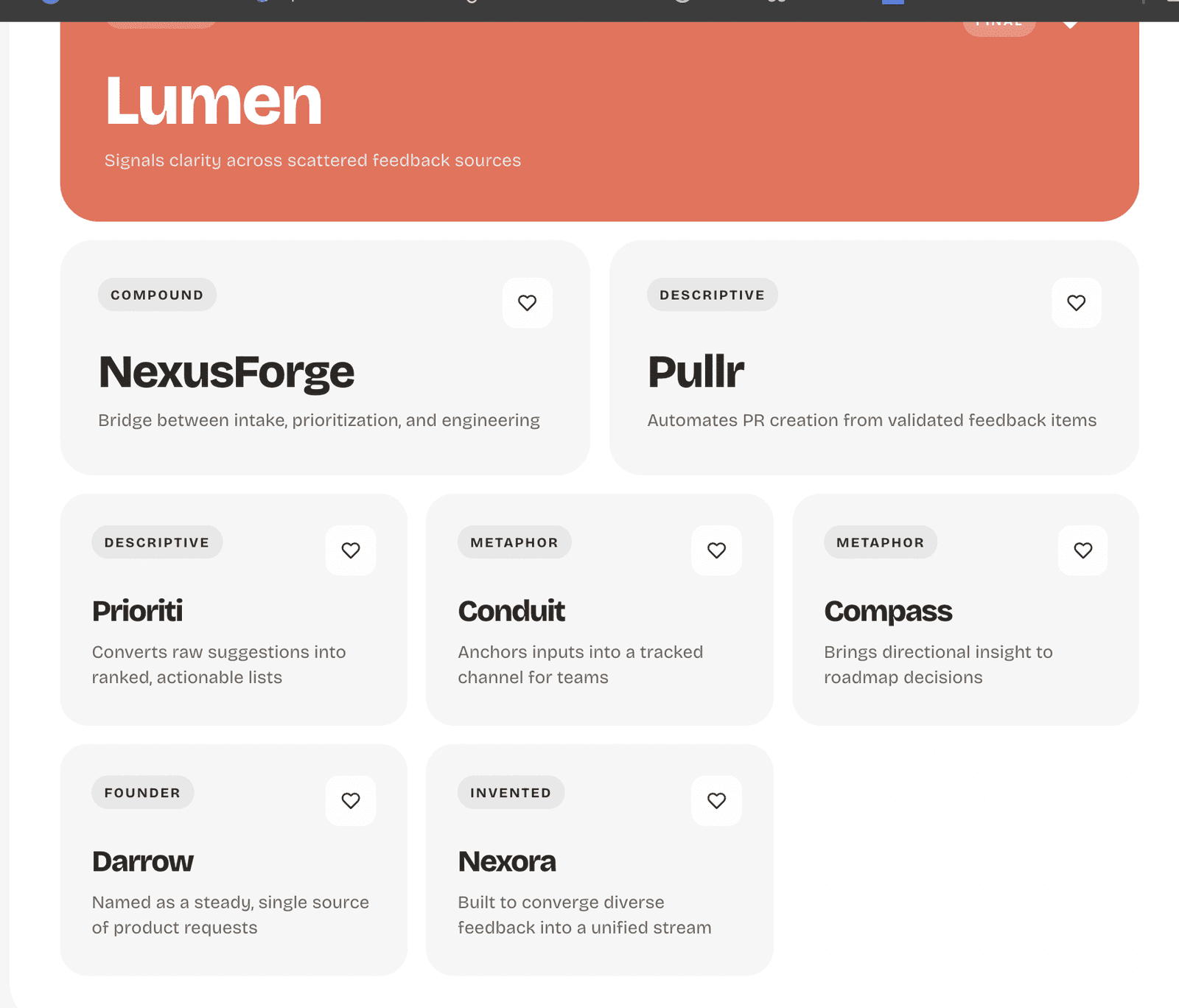
Its winner was Lumen: it signals clarity across scattered feedback sources, light cutting through noise. The runners-up were the usual spread of startup-name shapes, the descriptive (Pullr, Prioriti), the metaphor (Conduit, Compass), the invented (Nexora). But Lumen was the pick, and it came with logos.
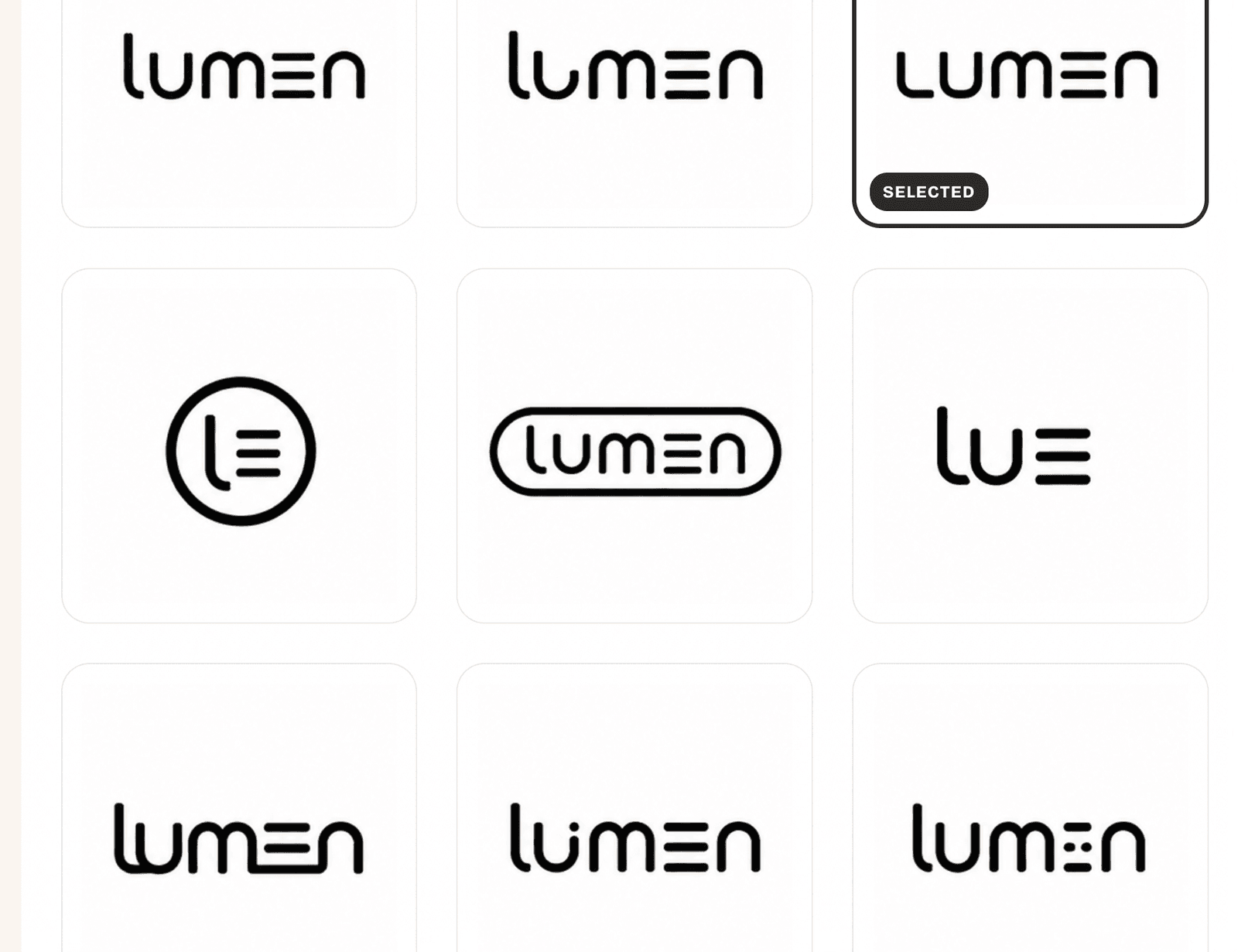
Total time, from one sentence to a finished brand board, was under half an hour. I have spent longer than that picking a single shade of blue.
Where I actually landed: I like it, but
So this is not a teardown. I want to be straight about that, because the easy post to write is the smug one where the AI face-plants and I get to look clever. That is not the post I have. The strategy copy it generated is, in a couple of places, sharper than copy currently live on my own site that I wrote by hand over a long time.
There is one aesthetic doubt I will own before the bigger problems. Lumen is on-trend in the worst way. Light, clarity, signal: every third AI startup this year is named some variant of glow. It is clean, but it might be clean the way everyone else is clean. Set that aside though, because two harder things stop me cold.
First, the name is taken. Heavily. There is Lumen Technologies, a telecom company you have probably seen on a bill. There is Lumen, the metabolism device people breathe into. The AI never checked a trademark register or a search result. It picked a word that sounds like clarity and handed it over with full confidence, no idea I would be fighting two established companies for the first page of Google on day one. For a bootstrapped product where organic search is most of how anyone finds me, a contested name is close to a deal-breaker on its own.
Second, it made things up about me. Among the goals it generated: two million in ARR and fifteen enterprise customers within twelve months, SAML SSO, twenty integrations, ten thousand feedback items a month. I am a solo founder, bootstrapping, and I have not landed my first paying customer yet. None of that is true. The AI had no way to know it, so it reached for the default shape of an ambitious B2B SaaS company and dressed me in it.
Which is the whole pattern in one place. On the conceptual work, understanding the product, finding the wedge, writing the line, it beat my current copy. On the worldly work, what is already trademarked, what is true about my business, what I can realistically own, it was confidently and cheerfully wrong. The same emptiness that makes it nail the positioning is exactly what makes it invent a company I am not running. I never gave it my reality, so it built one.
Would I actually do it?
Probably not. But it is closer than I expected, and that surprise is the whole reason I am writing this down instead of closing the tab.
The case for switching: Lumen, or some untaken cousin of it, is a cleaner story than Usero. The light-through-noise line writes itself. The logo set is good. And doing it now, while almost nobody knows the name, is the cheapest this will ever be. Every month I wait, the rename gets more expensive.
The case for staying starts with the obvious. The name is taken and the SEO fight is brutal. But the real reason is the one I trust least about myself.
I have not landed my first paying customer. Renaming the company before you have proven a single person will pay for it is one of the most satisfying ways to feel productive while shipping nothing. A rebrand is creative, it is visible, it produces artifacts, and it conveniently is not the terrifying work of selling. I know this shape. I have watched other founders disappear into it for months. There is a real chance this entire post is procrastination wearing a creative-director costume, and the most honest thing I can say is that I cannot fully rule it out from the inside.
So I am not going to settle this alone. I am too attached to the old name and too charmed by the new one to be the right judge.
I spend all day building a thing that turns what users tell me into shipped changes, so it would be a little rich to make even this call in a vacuum. The vote is right below. Pick one, and leave a reason if you have one.
Go look at what the AI made. Weigh the two things it got wrong against the things it got right. Then tell me what you would do: keep the name I have lived with for a year, or take the clean story from a machine that has known me for one sentence.
I will probably keep Usero. But I am genuinely curious what you would do, so the vote is right there.
Keep usero, or rebrand to LUMEN?
A name I picked myself and have used for a year, against a brand an AI built from one sentence. You break the tie.
Frequently Asked Questions
What is Branda?
Branda is an AI brand-identity generator. You give it a short description of your product and it returns a full brand direction: a positioning line, an archetype, a personality read, name suggestions, and logo treatments. In this experiment it produced a finished brand board, names, and nine logo variations from a single sentence in under half an hour.
Can an AI actually come up with a good startup name and brand?
On the conceptual work it was genuinely good. From one vague sentence it landed a category line close to my real positioning, read the right personality, and produced a logo set I keep coming back to. Where it failed was the worldly work: it picked a name (Lumen) that is heavily trademarked and never checked, and it invented business goals (millions in ARR, enterprise customers, SSO) that are not remotely true for a pre-revenue solo founder. The same emptiness that lets it nail the positioning is what makes it confidently wrong about reality.
Why did you only give the AI one sentence about your product?
The honest test of a tool like this is the clean room. If you paste in your whole pitch, anything good that comes back is just your own thinking bounced off a mirror. Giving it next to nothing is the only way to tell whether it understood the product on its own or repeated your homework back to you.
Should an early-stage founder rebrand based on AI output?
Probably not, and not for the reason you would expect. The bigger trap is that a rebrand is creative, visible, and produces artifacts, so it feels like progress while you ship nothing and avoid the hard work of selling. Renaming a company before a single customer has paid is one of the most satisfying ways to procrastinate. The strongest case for acting is timing: a rename is cheapest while almost nobody knows the name.
Continue reading
How Canny Autopilot Works: What It Automates, and What It Paywalls
We spent an evening inside a live Canny workspace tearing down Autopilot: Feedback Discovery, Post Deduplication, Smart Replies, Knowledge Hub, the credit meter, and the Pro paywall. An honest look at what the dedup toggle does, where it stops, and how automatic cross-source clustering handles the same job differently.
7 min read
Fix GitHub Issues Automatically: What Actually Works in 2026
Can AI fix GitHub issues automatically? An honest guide to turning a GitHub issue into a pull request with AI: Copilot coding agent, OpenHands, issue-to-PR bots, and the manual gh CLI route, where each breaks, and how to set up an issue-to-PR flow.
9 min read
Chrome Web Store Reviews: Find the Bug Hiding in Your Extension Reviews
Your Chrome extension reviews hide your worst bug under a dozen wordings, and the store dashboard never groups them. How to export and cluster Chrome Web Store reviews by theme, plus the tool that imports them with just your extension ID and turns the recurring bug into a GitHub PR.
6 min read
Build a feedback loop your team actually uses
Usero collects, clusters, and turns user feedback into shipped fixes.
Get started free